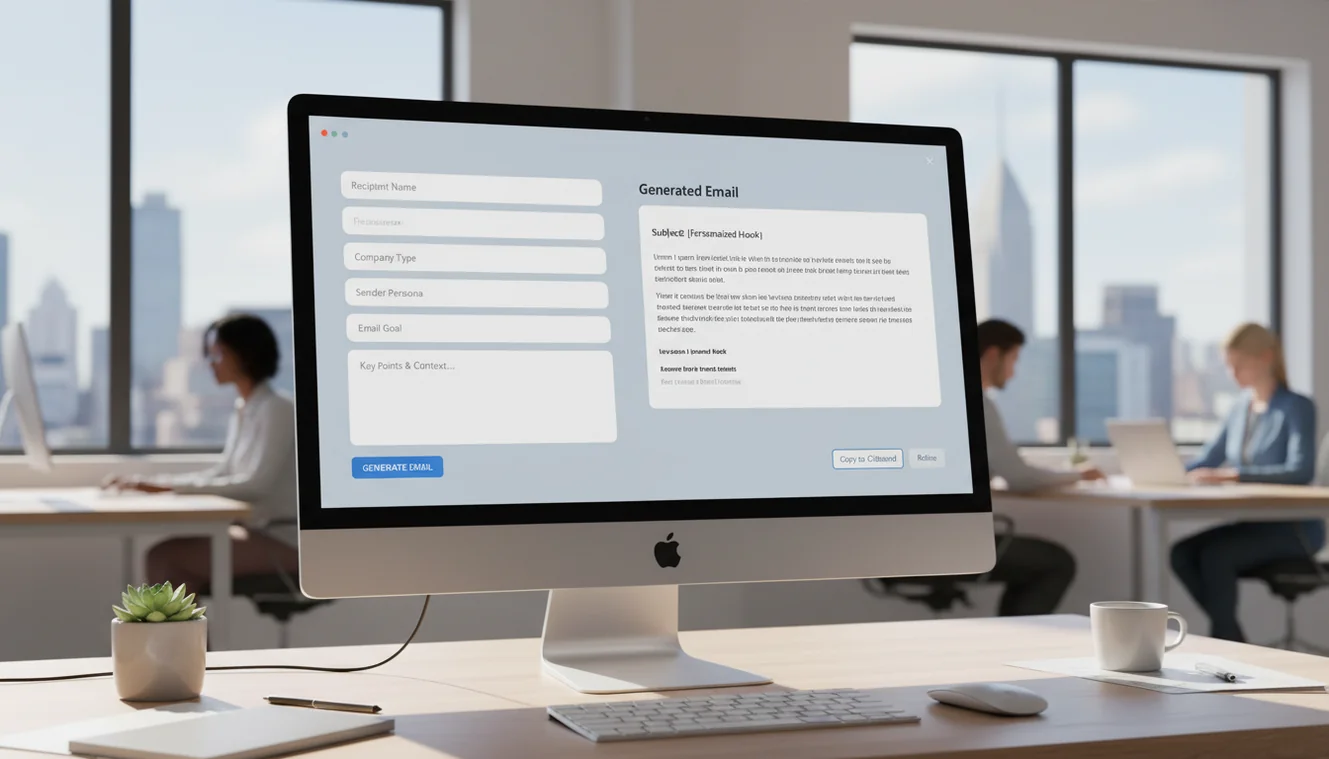
What cold email is and why it still works
Cold email is the practice of reaching out to people you have not previously communicated with for a business purpose. Despite predictions that cold email would die with the rise of social media and messaging, it remains one of the most effective channels for B2B outreach, hiring, fundraising, and partnership development.
The reason cold email persists is simple: business professionals live in their inbox. LinkedIn messages get lost in notification noise. Phone calls get screened. Social media DMs feel informal for business discussions. Email remains the channel where serious professional communication happens, which means it is also where serious outreach has the best chance of being received and considered.
However, cold email only works when it is done well. Generic mass emails that provide no relevance to the recipient are not just ineffective, they damage your sender reputation and your personal brand. Effective cold email requires research, personalization, clear value, and respect for the recipient's time and attention.
The structure of a cold email that gets replies
A high-performing cold email has five elements, and it fits in under 150 words.
The opening line is personalized. It references something specific to the recipient: a recent company milestone, a piece of content they published, a mutual connection, or a challenge relevant to their role. This signals that the email is not automated spam and gives the recipient a reason to keep reading.
The bridge connects the personalized opening to your relevance. One to two sentences that explain why you are reaching out to them specifically and how your offering connects to their situation.
The value statement explains what you offer or propose in concrete terms. Avoid abstract claims like "we help companies grow." Instead, use specific language: "We helped a similar company reduce their email response time by 40%." Specificity creates credibility.
The call to action is one simple request. Not "let me know if you're interested in a 30-minute demo" but "Would a 15-minute call on Tuesday or Wednesday work?" The lower the commitment you ask for, the higher the response rate.
The sign-off is clean and professional. Your name, title, and company. Nothing more.
Personalization: the difference between cold email and spam
The single factor that separates effective cold email from spam is personalization. Not mail-merge personalization that inserts a first name. Real personalization that demonstrates you spent time understanding the recipient before writing to them.
Effective personalization takes 2 to 5 minutes per recipient. Look at their company website for recent news. Check their LinkedIn for role changes or published content. Read their company blog for strategic priorities. Then reference one specific finding in your opening line.
This research investment is what makes cold email scalable but not fully automatable. You can use AI to draft the body of the email based on your value proposition and the recipient context. But the personalized opening that earns attention must come from genuine research. The combination of human research and AI drafting is what produces cold email at quality and volume simultaneously.
The math works out clearly. If you spend 3 minutes researching and 1 minute generating and reviewing an AI draft, you produce 15 personalized cold emails per hour. Without AI, you might produce 5 to 8 in the same time. The AI doubles or triples your throughput while the human research maintains quality.
Cold email compliance and ethical considerations
Cold email operates in a legal and ethical framework that varies by jurisdiction. In the United States, the CAN-SPAM Act sets the baseline: use accurate sender information, write truthful subject lines, include your physical mailing address, and provide a clear way to opt out. Violations can result in penalties up to $51,744 per email.
The European Union's GDPR imposes stricter requirements, particularly for B2C cold email. B2B cold email is generally permissible under the legitimate interest basis, but you must still provide opt-out mechanisms and handle data responsibly.
Beyond legal compliance, ethical cold email practices include: only emailing people who are plausibly interested in what you offer, keeping volume reasonable, respecting opt-out requests immediately, being honest about who you are and what you want, and not using deceptive subject lines or false urgency.
AI cold email generators can help with compliance by producing drafts that include required elements like opt-out language. However, the responsibility for legal compliance rests with the sender, not the tool. Ensure your cold email practices comply with all applicable regulations before scaling outreach.
Cold email sequences and follow-up strategy
A single cold email is rarely enough. The standard cold email sequence includes 3 to 5 touches spread over 2 to 4 weeks. Each message in the sequence should build on the previous one while adding new information or a different angle.
A typical sequence looks like this. Email one is the initial outreach with personalization, value proposition, and call to action. Email two, sent 3 to 5 days later, is a brief follow-up that references the first email and adds a case study, statistic, or additional angle. Email three, sent 5 to 7 days after email two, takes a different approach, perhaps asking a question about a challenge they might face or sharing a relevant resource. Email four is a final breakup email that says something like "I do not want to keep filling your inbox, so this will be my last message unless you would like to connect."
Each email in the sequence should be shorter than the previous one. The initial email might be 120 words. The follow-ups should be 50 to 80 words. The breakup email should be 30 to 50 words. Brevity signals respect for the recipient's time and increases the likelihood of engagement.
How AI cold email generators fit into the outreach workflow
AI cold email generators are most useful for creating the structural framework of cold emails: the bridge, value statement, and call to action. These elements follow patterns that AI handles well because they draw on established outreach best practices.
The workflow is: research the recipient manually, draft a personalized opening based on your research, use the AI generator to produce the body of the email with your value proposition and desired call to action, review and combine the elements, and send.
For sequence building, AI tools can produce the multiple follow-up variations quickly. Instead of writing three different follow-up angles manually, describe each angle and let the tool draft the variations. This is particularly useful because follow-up fatigue, where each subsequent message feels harder to write, is a common reason cold email sequences get abandoned after two emails.
The limitation of AI in cold email is the same as its general limitation: it does not know the recipient. It can write a compelling pitch but cannot write a personally relevant opening. Use AI for scalable elements and human judgment for personalized elements. This combination produces the best results at meaningful volume.
Measuring and improving cold email performance
Track four metrics to evaluate and improve your cold email: open rate, reply rate, positive reply rate, and conversion rate. Open rate measures subject line effectiveness. Reply rate measures overall message quality. Positive reply rate separates interested responses from rejections or unsubscribes. Conversion rate measures how many replies turn into the outcome you wanted, whether that is a meeting, a sale, or a partnership.
The most actionable metric for improvement is reply rate. If people are opening your emails but not replying, the problem is in the body: your value proposition is not compelling, your call to action requires too much commitment, or your message does not feel relevant to the recipient. Test different approaches systematically by changing one element at a time.
Subject line testing has the highest leverage for open rate improvement. A/B test two subject lines with small groups before sending to your full list. Specific subject lines that reference the recipient company or role typically outperform generic ones. Questions outperform statements. Short subject lines outperform long ones.
Review your data weekly and adjust your approach. Cold email performance improves dramatically with systematic testing because the feedback loop is fast: you send emails, measure results, adjust, and see the impact within days.